Author name: Dev Gravitable

Not Tantra

What is the difference between Sex Positivity and Conscious Sexuality and Tantra?

Sex Positivity, Conscious Sexuality, and Tantra—What’s the Difference? Sex positivity, conscious sexuality, and Tantra are often spoken about interchangeably, but they are three distinct things—so why is Tantra being used as a catch-all term for everything from sex parties to conscious sexuality workshops? Let’s break it down. Sex Positivity: The Philosophy That Sex is Intrinsically Good Sex positivity is the idea that sex is an intrinsic good, much like food is an intrinsic good. That doesn’t mean we can’t misuse it—just as eating takeaways every day will make us ill, unhealthy sexual dynamics can have negative effects. But that doesn’t change the fact that sex itself is an intrinsic good, something natural and valuable. Conscious Sexuality: Awareness, Consent, and Healing Conscious sexuality is the idea that we can approach our sexuality consciously. Under this umbrella, there are many practices that support people in letting go of shame, developing a clear focus on consent and boundaries, and reclaiming autonomy and pleasure over their own sexual experiences. Tantra: A Spiritual Path, Not Just a Sexual Practice And Tantra—Tantra is a spiritual path. It is a set of practices and a worldview that sees sexual energy as life energy, something we can work with to dissolve the ego and experience a deep, felt sense of interconnectedness—a way of accessing an intelligence beyond the self. Tantra understands that trauma stops energy from circulating. Within Tantra, there are many techniques that can help release trauma from the body, release repressed emotions, and let go of physical tension. It is a spiritual path. These are three very different things—so that begs the question: Why is Everything Called Tantra These Days? Why are so many conscious sexuality events called Tantra? Why is a sex party—for want of a better word—called a Temple? I think the reason for that is both interesting and sad. Conscious sexuality wants to differentiate itself from sex parties. And it does that because of internalized societal shame. Sex parties are seen as bad, so conscious sexuality wants to say, “We’re not that.” By appropriating spiritual language and calling itself Tantra, it ends up internalizing the very shame it was trying to challenge. But conscious sexuality is important. We have the right to enjoy our sexuality and our bodies in whatever shape or form feels right. Conscious sexuality creates spaces and practices that allow us to do that. And I think it’s time that conscious sexuality calls itself what it is. We are consciously sexuality, and we are important. Not Tantra. Conscious Sexuality. And maybe, just to end on a positive note—sex positivity is wonderful. It’s a wonderful philosophy. We should be positive about sex and see it as an intrinsic good, even if, for various reasons, we can sometimes use it unwisely—just like food.

Not Tantra

Why is Tantra so white?

Bloody good question, isn’t it? Considering Tantra is a nonwhite tradition, rooted in the Indian subcontinent, you wouldn’t think so if you looked around at most Tantra teachers and participants in the West. There’s a difference between using language to make something accessible to a different culture, time, and place—and appropriating a tradition without recognizing the shoulders we stand on. Tantra comes from people who, despite colonialism, have somehow managed to hold onto a non-dualistic understanding of the world—and practices that support healing and living in that way. For that, I feel tremendous gratitude. But Tantra in the West has never been allowed to be what it traditionally is. Tantra is Part of a Web of Meaning Traditionally, Tantra is not an isolated practice—it exists within a much larger web of meaning. It is part of a wider worldview, just as science offers us a framework for understanding reality. In its original form, Tantra wasn’t just a tool for self-improvement—it was part of an interconnected system of philosophy, ritual, cosmology, and ethics, woven into daily life, relationships, and spirituality. It wasn’t something you just did—it was a way of being and understanding the world. Tantra is Not Just a Self-Development Tool And yet, in the West, Tantra has been extracted from this web of meaning and turned into a self-development practice. It has become something you “do” to develop yourself, to make yourself a better, more effective individual—as if that were its purpose. But Tantra isn’t a self-improvement tool. It isn’t about making you a better lover. Yes, it has sexual teachings—but they are a tiny, tiny part of the vast body of Tantric wisdom. And yet, as with Buddhism, as with shamanic traditions, Tantra has been assimilated into an individualistic, Western self-development culture. With its ‘exotism’ and it’s assoication with the errotic its become a premium ‘label’ to attract middle-class white people with money—those who have the time, resources, and privilege to invest in self-improvement. And because of this the people who access it are predominantly white and privileged. And that’s deeply sad. Tantra is a Path to Healing and Connection Tantra is a powerful healing modality. It offers a path to experiencing the world differently—a way out of the exhaustion of figuring it all out alone. It can offer a felt sense of being held in love, of being both part of and separate from everything else—something so needed in these times. Tantra can offer a way to heal trauma, a map of reality that challenges individualism and capitalism, showing us a different way to be and relate. But instead of being honored as a living tradition, Tantra in the West has become a product—something that only privileged, prodomently white people can afford. And that makes me deeply sad.

Tantra

Tantra and social change

This question is really dear to my heart and relate to another project that I’m doing called organizing from elsewhere. You’re really welcome to to read more about that on our website. The practices that I share. I’ve learned. Europe is the first colonized people. We killed the pagans. We killed the witches. We have no memory. Of our own non dualistic understanding of how the world works. You know, we’re all post-enlightenment here. We’re all zeros and ones and binary and separation and Descartes, you know the spirit from the body and from that. And I’m deeply grateful for my own healing. To the people that we massacred and slaughtered and culturally killed, you know, the indigenous peoples who somehow, despite hundreds of years of annihilation. Held on to this non dualistic understanding. In a previous video, I talked about assimilating. So they have managed to whisper back to us these other ways of understanding the world and these practices that can give us this non dualistic experience of reality. And we assimilate it. So at the moment we’re only allowed to practice this. Within the framework of self-improvement. I’m fucked up. It’s my responsibility as I’m separate from everybody else and everything else, to sort out my fucked up. This, to be a better person, to be a healthier person, to be a better worker, to be able to achieve and be successful and worthy. And then we move to plant medicine, to therapy, to tantra, to heal my trauma, to. I don’t know. But these practices, they weren’t self-improvement tools. They existed within a web of meaning, a way of understanding the world, and a way of living with each other. In relation. In relationship. In relationship with all that I am now, that means my children, my partner, my family, my community, my society, my ancestors. The land that I’m on. The nature that I’m part of. These practices came from how we move and decide and live in relation. A felt experience of non dualism. I believe that we need to take these practices out of the box, that step one is to work with trauma. Step one is to decolonize, to understand our ways of thinking, our colonial mindset of separation, a patriarchal racist mindset of separation. Become aware of it so that we can look at it. To work with trauma, to learn practices so that our resting point of consciousness can be one in which we experience the world much more as both separate and part of, and then to look at how we can move and live and decide together from that place. I believe these practices, and many indigenous and wise communities. Have much to say and to show us. About how we can learn to make decisions together and act together from a fundamental assumption of interconnectedness. There isn’t time in this video to explore that more, but I would encourage you to explore our website organizing from elsewhere, which is looking to support social movements to use these principles and understandings and practices to organize for social change more effectively, and how we can support those that are moving to intentional community living to really take a decolonial attitude towards it, and to avoid replicating the very cultures that they’re trying to change, amongst other things.

Tantra

What is a chakra?

What is the chakra? We have a physical body and we have an energetic body. And we have ways that energy, sexual energy, life, energy circulates around the body. Its physical manifestation might be understood or conceptualized as how? Nervous system. Yeah, but energy also circulates in particular ways around the body. And there are various maps that are of how that happens and how that works, linked to various traditions. So in the Taoist tradition, you would use the microcosmic orbit as a map to try and understand how energy would circulate. And in the tantric tradition, you would use a map called the chat cross system. There are many chakras in the body, okay? But generally when people talk about chakras in the West, at least we’re talking about several points in the body, sort of the root chakra, the sacral chakra around the solar plexus and the heart and the throat. And the third eye and the crown, which if we just go back to your nerve system analogy, there are places in the body where lots of nerves gather. So the chakras system could be understood as points where energy, so. Can plug in and plug out. So another really interesting thing to understand about the the chakra system is it’s. How energy circulates within our body, but it’s also how our energetic system plugs in and plugs out of receiving and giving energy or receiving and giving information. And I would argue that energy and information are very, you know, consciousness or really wrapped up in, in one concept. So. Each chakra system can move in a plus or a minus. We can learn how to receive energy in that chakra or send our sexual energy, our life energy through that chakra. I think that for this video, that’s enough.

Tantra

What is a Yoni and what is a Lingam?

I wonder if this clip is going to get past the censors or our big right wing tech billionaires. Again, I think it’s important to define because these terms are used often, and for a lot of people off. Yoni and lingam can be translated literally to penis and vagina, but it has another quality. So it’s talking not just of the physical vagina and the physical penis, but of the energetic vagina and the energetic penis that exists in the energy body. Now, again, this is a bit confusing because they don’t look or quite operate like the physical vagina or the physical penis in some sense. And this is important because I have. An energetic vagina located around where my penis is. The picture that as, energetically, my and I also have an energetic penis as well as my physical penis. So conceptualize that that I can both energetically send energy out a picture, a plus sign. Yeah, polarity was energy out. Now that would be through my energetic penis or my lingam. But I can also pull energy in, through my energetic yoni here. And that’s regardless of my physical penis being that because there is a relationship between the physical body and the energetic body, because I have a penis and because I’m used to when I have sex, you’re not sort of giving energy thrusting, penetrating. I generally find it easier to send energy out of this lower chakra. And, you know, somebody who’s got a vagina, who’s more used to sort of taking things in their will, find it easier to receive energy that but that does not mean that with that, just even a little bit of training and intention, I can’t learn to receive. And, you know, someone with a, a physical vagina continent to give that, and that’s important. We’ll explore more of that if you come and do work with me about how we work with the chakra system for for circular energy. But in short, yoni and lingam is a word for penis and vagina that incorporates the energetic aspect, not just the physical aspect of that chakra.

Tantra

What is a ritual?

What is a ritual? A ritual is guided by some principles. The first is that there is ritual space and ordinary space that are delineated. The second is that rituals always have a beginning and an end. The third is that there is a clear intention for a ritual. And the fourth is that a ritual is done with presence. And. The clearer the intention. And the more presence that a ritual is undertaken with. The more clearly a ritual is marked with a beginning and an end and ritual space and ordinary space delineated. The more powerful the ritual. Now, that may sound quite woowoo to a lot of you, but we’ve been using ritual, I think, for as long as human beings have been around, because it works and we use them every day. Now, a meeting, for example, is a really good example of a ritual that we all know well, and we all know that declare the intention of a meeting. And the more present we are in the meeting, the more clearly the meeting has boundaries around it, the more effective a meeting is. And okay, we don’t know how ritual works, but we know that it does. And we use many technologies that we don’t understand. You know, anti-depressants, some serotonin, some reduce serotonin. We use it because they work. And what can be achieved when done ritualistically is far more effective than when the very same thing is done outside of a ritual. So in my work and in my life, I use the technology of ritual, to move more wisely and more effectively in life. And I think that when ritual is understood that way, and once you practice it and you start to see that it actually is supportive. It’s interesting to see how we can bring those principles of ritual into different practices, quite simply, in our everyday life.

Tantra

What is Kundalini?

What is Kundalini? That’s actually, reminded me of a very funny song that, I heard recently. Kundalini is an energetic pathway that runs. Up the spine. But again, this is hard to convey because it’s physical and it’s energetic. Yeah. And it runs really from the the root chakra, which is a node, point, an energy point in the body sort of all of the way up to the crown chakra, which is another sort of energetic node that is sort of represented in the energetic body. It’s a it’s a pathway, within which life energy, sexual energy can travel up. And we have another sort of front channel that runs also down. And it’s a little bit hard to conceptualize. But the reason I think it’s worth mentioning is that people can talk about Kundalini as if it is an energy. It’s not an energy. It’s, a route, a pathway through which energy can travel. And, you know, the the tantric tradition has a particular map. The Taoist tradition has a particular map. But that’s the point that I want to make. And the reason it’s important is trauma. Repressed emotions, physical tensions create blocks in the candle. Any pathway. And when those blocks start to release, we have things called Kundalini awakenings. And suddenly all this sexual energy that’s been building up here, right, starts to be able to move up and we start to be able to experience a lot of pleasure in the body. But at the beginning, sometimes also a lot of pain and people can shake and have, you know, really odd experiences as sexual energy starts to build, you know, so, you know, like you can see that, you know, it’s fine now moving my energy up, I’m, I’m shaking. And that shaking is actually because I’ve still got traumatic blocks in the body. You know, when I’ve really done my work energy of circular up and I won’t shake, but I, I talk about it to delineate the energy and the pathway and also to explain what many people can experience as they start to release traumatic blocks and energy starts to move and they start to shake and experience both pain and pleasure, as energy can start to move more freely around the energetic body, in the physical body.

Tantra

What is the divine?

What is the divine? So just, a small question for me. There. I’m not going to try and answer what the divine is, but I think it is helpful to talk a little bit about what I understand the word divine to point towards. And the for me. Whether you are a rationalist, a scientist, spiritual or religious, I think we all have these moments in life. Where we have a sense of its inexplicable ability, its unexplained ability. You know, I I’m awake, looking out. And science can’t explain it, and we don’t know what it is. And, you know, I’ve been awake for as long as I’ve been here. Yeah. And at some point I’ll die and disappear. And it’s kind of inexplicable. And so much of modern society ignores that mystery and is based on this assumption of separation. I’m even separate from my body, you know, I’m here. My body is here. You’re there. Everything is separate, you know? And upon this, the epidemic in in mental health crisis. Because I’m alone. I’m not good enough. I’m separate. I’m lonely upon this. You know. Key concepts of capitalism, you know, individualism, competition, private property. I can treat someone badly because they are not me. I can have dominion over nature. And we can cause the climate crisis because of this idea of separation. So for me, the word divine could easily be replaced by interconnectedness that. Whether you arrive at this conclusion by quantum theory, by the latest understandings of complex systems, or you arrive at this understanding through spiritual teachings, or you arrive at this experience by taking psychedelics or tantric practices, there is a truth that reality is non dualistic. That I am both separate and part of everything. That if we took a magnifying glass we would go down to atoms, cells, particles hovering in space that I’m made up of exactly the same stuff as a computer to, you know that and small enough, everything is a wave and a particle is energy moving. And that it is intelligent and knowing that all information is there. Forms this. Complex. Inexplicable. Web. And for many. That is what I’m pointing at with the word divine or interconnectedness.

Tantra

Tantric principle of polarity

What is the tantric principle of polarity? And this is something that I feel quite strongly about. If any of you who have gone to a tantra workshop, you may have come across something like this. Polarity is one energy expressed in two polarities masculine and feminine energy. And masculine energy is decisiveness and leadership and direction, and all the qualities that give men the right to rule the world. And, you know, feminine energy is Shakti. It’s chaotic. It’s this. It’s that and all the reasons that women shouldn’t be in charge. And it’s a load of ballocks. It really is. I think there’s a lot of confusion between three different things. One of that is sex. And by that I just mean what genitals do we have? What sexual organs do we have? Do we have a penis? Do we have a vagina? Do we have breasts? Don’t we have breasts? The other is gender. And by gender I mean the personality traits which we are told are associated with having particular genitalia. Like if you have a penis, you’re supposed to be aggressive or to be decisive. If you have a vagina, you’re supposed to be carrying nurturing, emotional. And then there is what is often termed masculine and feminine energy. So what do we mean by masculine and feminine energy? What do we mean by polarity? If in tantra everything is experienced in the body. Then these energies, these polarities are not gender qualities. What is the experience of polarity? Form. And when? There is this word and there is awareness of this word. There is this harm and there is awareness of this. And. If there was no hand here, there’d be nothing to be aware of. If there was no awareness, I wouldn’t know what I was saying. I wouldn’t be aware of the existence of the hand. There is always this dance between form and awareness, all way. In Tantra, we learn how to expand out, out cinematically. The experiences of going out. Forms appear in the loving blue sky of our. Awareness like clouds. And this polarity. This energy has a slight order in quality. You know, forms take shape and awareness. And we learn practices to go cinematically in the experiences of going in to the birthing experience, you know, emotions, thoughts, time, life. We’re not even aware that we’re aware. And in Tantra, we practice this dance by separating these things out. And when you separate these out, an energy is created drawing them together. And in that joining form and awareness, there is an explosion of energy that supports us to shift consciousness. We can do these practices within ourselves. Expanding our and holding emotions and thoughts. Experiences, tastes. In this conscious, loving container of awareness. And we practice going in to experience really feeling and birthing. We practice this dance within ourselves and the energy it creates. And we practice this dance with others. And it’s a really powerful principle, which there’s much more to be said on, and a really important principle.

Tantra

What is manifestation and sex magic?

What is sex magic? Let’s start with what is sexual energy? Sexual energy is life energy. It’s the energy that births everything from cells to stars. It’s so powerful. I mean, it’s from sexual energy that a baby is born. With this understanding of sexual energy, we start to understand that this shift from the immaterial. If you want to use a scientific language, the wave, the interconnectedness. Into a particular form. This word, this computer, this human being, this baby, this emotion takes a lot of energy. And that energy is sexual energy. The reality is that we’re always both a little bit like a wave in the sea. There. It swells up on the ocean and it goes, oh, I’m a wave, I’m a wave. I’m. I’m all alone. And after a period, it crashes back down into the sea. And it’s true. It is a wave. It is in a different form. But it was always part of the ocean simultaneously. And that movement. Is driven by sexual energy. Sex, magic and manifestation. Are closely linked. Books like The Secret. If you think the right things. If you do certain things, you can have whatever you want. A part of capitalism’s attempt to blame individuals for their situation. If you had cancer, it’s because you had the wrong thoughts, the wrong beliefs, not because you were breathing in pollutants from the nearby factory. If you’re not rich and successful, it’s not because the 1% of extracted, you know, more wealth than ever before in human history, leaving very little for the rest of us so that social mobility has died. It’s again just a case of having the right intentions and the right practices and the right beliefs. And yet. We do manifest. We do create. And there are. Laws. And by laws I mean not rules, but just the way the world works. Like water runs down the kill. Time passes and we die. So sex magic manifestation. Are about learning how to work with this creative force. Of sexual energy. Of life. Energy wisely. To move with that flow of creation. And I think that’s all that it’s really appropriate to share in this video.

Tantra

What is an energetic orgasm?

What is an energetic orgasm? It’s interesting. I notice almost. A reluctance to use the word orgasm, because when I use the word orgasm, I think that for most people, we have a a clear idea of this friction on the clitoris or on the penis. This buildup of energy in the sex and the very, you know, strong, sometimes very pleasurable experience. An energetic orgasm is what happens when that energy is no longer trapped in the sex. So when we’ve used tantric techniques to remove the traumatic blocks and the repressed emotions and the physical tensions that stop sexual energy moving up the body, we experience an energetic orgasm. It’s full body. And it can be very intense. And there are a number of types of energetic orgasm. So an energetic orgasm, when you are circulating the energy either by yourself or with a partner. Is this intensifying state of pleasure and psychedelic experience of expanding out it? The first time that I was really able to do that with a partner, it changed my understanding of what sex could be. You know, time was falling. It was like taking mushrooms. It was very, very powerful. And it’s not peak. It goes on and it goes on and it’s extraordinary. And there are other forms of energetic orgasm where you’re building up sexual energy, and then you’re using sort of tension. Certain techniques to push the energy up. And that’s again very, very intense. You know, it’s literally like you go like, a small mushroom trip. And that is technically or experientially what an energetic orgasm is when you’re moving that angle. But the reason it’s important is it’s a path. When we circulate energy like this and we expand out. We are able to connect with vast wisdoms, vast intelligences. You can understand that in the spiritual sense, or if you like, you can understand that there is just a lot of information, knowing that you are able to receive into the body and to know. But it’s also a buildup of sexual energy. And sexual energy is the energy that that creates things. So from this space, it’s possible to heal, to direct the sexual energy to points in the body or to others, to to create quite powerful healings of physical and psychological and emotional and spiritual wounds. And although I’m nervous to say this, and I will talk more about this later, because it’s a creative energy, it can be directed through energetic orgasm to manifestation. And by that I do not mean, you know, making the world exactly as I want it. Getting my Lamborghini and my million dollars. I simply mean I’m manifesting these words. I’m creating these words. We are creating this video, this movement between the immaterial and the material requires energy and has ways of moving. But I’ll speak to that more, I think, in, in a separate video. So just to wrap that up, an energetic orgasm is what’s happening when we learn how to work with our sexual energy, when we learn how to build it up and then move it and circulate it around our body or around our body and our partners body, it’s very pleasurable. It’s very powerful. Yeah.

Tantra

What is the energybody?

In the Tantric tradition, the body is understood to be both physical and energetic, with seven layers of energy surrounding it. I don’t know if that’s true, but I do know there are at least two—because I can feel them. I can feel one layer close to my body, and if I push through, another a little further out. As I do, waves of sensation move through me—subtle yet unmistakable. The energy body is made up of these energetic layers that surround the physical body. What they are, exactly, might be beyond me—but that they exist? That’s something I know from experience. Just like I can feel the breeze, I can feel this magnetic push, this gentle resistance. And with practice, we can do more than just sense them with our hands—we can actually expand out into them. Each layer has a slightly different quality of awareness. A little like how I feel different when I’m watching a movie compared to when I’m talking to you right now, or when I’m meditating. As I expand my attention outward into the different layers of my energy body, I’m still aware of my separation, but my sense of self starts to dissolve—just a little. When you reach the fifth or sixth energy body, that’s where things start to feel like astral projection or travel. For me, when I facilitate this kind of work, I’m often in my second or third body. It feels like I’m stepping aside and being moved, rather than doing the moving. And in these states, I perceive things that I simply can’t when I’m just anchored in my physical body. That’s really the best answer I can give—not as a theory, but as something real, something that can be felt.

Tantra

What is Tantra got to do with healing and trauma?

What is Tantra got to do with healing and trauma? Tantra understands that health is when our life energy, our sexual energy can circulate around the body. And Tantra understands how important it is to be able to circulate this energy, to dissolve this sense of I and start to have this experience of interconnectedness, of being part of and separate of this vast web of life, and to start to move and be guided by that intelligence. So in tantric traditions, there’s a lot of emphasis in removing the blocks that stop energy from circulating. And those blocks are understood to be trauma that is stored in the body. And causing that no. Yes. Energy to not be able to circulate, not be able to move. It understands that repressed emotions again stop energy from circulating. And it understands that physical tension stops energy from circulating. So there are many, many tantric techniques for removing these blocks. The armoring techniques for removing trauma physically from the body, which is a kind of trigger point to massage cathartic meditations that are very, very effective at releasing repressed emotions. You know, emotions are energy in motion. And, you know, lots of problems are caused when they’re stuck. But when they move, they turn into pure potency as they flow and physical tension through lots of yoga postures. And this is kind of now accepted in sort of mainstream discourse through books like The Body Keeps a Score and it’s branched off and called smash Trauma Work. But the roots are in tantra. This understanding of trauma in the body, and that repressed emotions and trauma really caused a lot of problems and somatic techniques for releasing them. We really owe to tantric traditions and personally, I’m very grateful to the healing that they have provided. And that is why a lot of people that are struggling with trauma or poor health find that tantra is very beneficial.

Tantra

What is tatra actually?

What is Tantra? Actually? Well, the key line for me in the tantra is what is elsewhere is here. And what is not here is nowhere. What that’s understood to mean is that unlike in other traditions, where the body is seen as a block to enlightenment, Tantra believes that in this incarnation, in this dualistic existence, the path is through the body, that everything exists in the body. All time, all space, all my pain, all the pain of my family, of my grandparents, of their grandparents, of my entire lineage, all the pain of my friends, of my community, of my society. All the pain of the world. Going on in Gaza, Sudan, the Ukraine and all the love. All the love of all time, of all space. Everything is here. And if it is not here, it is nowhere. And that is a key, key principle of tantra, that the path is through the body, and that everything is in and through the body. The other key concept for me, for Tantra, is that tantra is the teaching of something beyond language, without language, that it is a a non. Linguistic modality. A good tantra teacher will share only in words what is needed to enter a practice with the right attitude and the right technique. And then the lesson is always in the meditation itself. In the practice itself. And to get to enlightenment. And by that I mean. An expanded sense of self. A sense of interconnectedness. A sense that I am both separate and part of this greater interconnected web of life. The awareness and intelligence. That I am you, this big. You that to get there. This ability to access this vast intelligence that we’re part of, it’s through the body. Sexual energy is understood to be life energy. This is the energy that births everything from cells to stars. It is the act of manifestation of creation. You know, these words did not exist. And they are birthed. They are manifested. They are created from formlessness to form. And that this is the act of sexual energy. This is the role the sexual energy that health, vitality and the ability to connect to the vastness of the world in which we move is when this energy can circulate around our body. And to do that, we need to remove the blocks. And these are traumatic blocks that are stored in the body blocks caused by repressed emotion and blocks caused by physical tension. And perhaps, maybe a slight subtlety is that the body is not just understood to be a physical thing, but to have energetic representations that there are, according to the tantric tradition. Seven layers of energetic body that also exist, and all of those need to allow energy to circulate freely. And Tantra, in short, offers techniques that enable us to work with our sexual energy to release these blocks for health and to experience this sense of interconnectedness, this ability to connect with a vast wisdom. And to create, to manifest in accordance with these laws and movements of reality.

Uncategorized

Is Tantra simply a marketing gimmick for the rich?

Here I am, surrounded by the smell of sage. I find myself in a room covered in mattresses and filled with people dressed in lingerie. The facilitator, clad in white robes, welcomes us to a ‘Tantric Temple’. They speak about the divine, how sexual energy is holy and how it will heal the world. A few connection exercises later (think eye-gazing and practising saying “yes” and “no”) and the space is opened for people to connect sexually with each other. This, I am told, is Tantra. Today, everything is called a Temple. What used to be called sex-positive or conscious sexuality events are now termed “Tantra” or “Tantric Temples”, and this poses a real and present threat to Tantra itself. Let me explain why: What is Tantra? And why is it under threat? “What is Here is Everywhere. What is not Here is Nowhere.” This line from the Vishvasara Tantra encapsulates the essence of Tantra. Tantra is a spiritual path that believes everything in the universe exists within our body, and if we cannot experience something through the body, then it doesn’t exist anywhere in the universe. Sexual energy is understood as the life force that births all forms, from cells to stars. The path teaches embodied practices to circulate this powerful energy around the body so that we may dissolve our ego, connect with the greater intelligence we are part of, direct the energy to manifest material forms (it is capable of creating far more than babies), and heal ourselves and others. Tantra understands repressed emotions, trauma, and tension as obstacles to the healthy circulation of life energy and offers powerful methods to remove these ‘blocks’ from the body. Tantra can be understood as the teaching of something beyond language through the body. A good Tantra teacher says only what is necessary for participants to enter a practice with the correct attitude and technique. The lesson is always through the technique itself. Why is Tantra under threat? Tantra is increasingly confused with Sex Positivity, a philosophy that views sex as an intrinsic and necessary good, much like food, and Conscious Sexuality, an approach to one’s sexuality that supports a healthy relationship with one’s sexual pleasure. One significant reason for this confusion, in my view, is the cultural shame that our society holds regarding sex. In an attempt to ‘broaden’ their market, those who facilitate sex-positive and conscious sexuality events appropriate spiritual language to differentiate themselves from being seen as ‘mere sex parties.’ This is having a terrible effect. It undermines the importance of Sex Positivity and Conscious Sexuality, which create vital, valuable spaces in which people learn to connect with their desires in healthy ways and to experience HEALTHY pleasure without shame. Even more worryingly, the effect of this confusion is to associate Tantra with sex, which obscures the true power of Tantra as a spiritual path and as a healing modality, particularly in relation to trauma. Moreover, as the term Tantra loses its meaning and is assimilated into our Western worldview, key tantric concepts become corrupted. Take the tantric teaching of polarity: the idea that there is always ‘form’ (for example, these words) and ‘awareness’ (an ever-present consciousness within which these forms exist). This concept has now been widely assimilated into our toxic patriarchal notions of gender. Shockingly, this powerful teaching has been twisted and robbed of its meaning to such a degree that, unfortunately, if you attend a ‘tantric’ event, you are likely to hear a nonsensical definition of polarity that goes something like this: “There is ‘masculine’ and ‘feminine’ energy”. Masculine energy represents leadership, direction, and strength—all the qualities that supposedly give men the right to rule the world. Feminine energy, on the other hand, is emotional, chaotic, and unstable—all the reasons we are told leave women unsuitable for power. The assimilation of Tantra into Western culture and its association with sex has, of course, led to increased interest in the term. This then leads to its commodification. If a ‘product’ is labelled ‘tantra’ or ‘tantric,’ it can command a higher price. This has led the cost of so-called ‘tantric’ events to spiral to truly shocking levels. The effect is disastrous. Access to sex-positive, conscious sexuality and genuinely tantric events is now so extraordinarily expensive that only the rich and privileged can attend. This has turned such important modalities—modalities that should be widely accessible—into playgrounds for the wealthy. It is my hope that we can stand up for the importance and beauty of Sex Positivity and Conscious Sexuality rather than hide them away under pseudo-spiritual language. It is my hope that Tantra can extract itself from the spiral of commodification and assimilation it seems caught in and be seen for the powerful, healing spiritual path that it is. Thank you for reading this month’s reflections.

Uncategorized

A Tantric Approach to Emotional Regulation: A Practical Tool for You

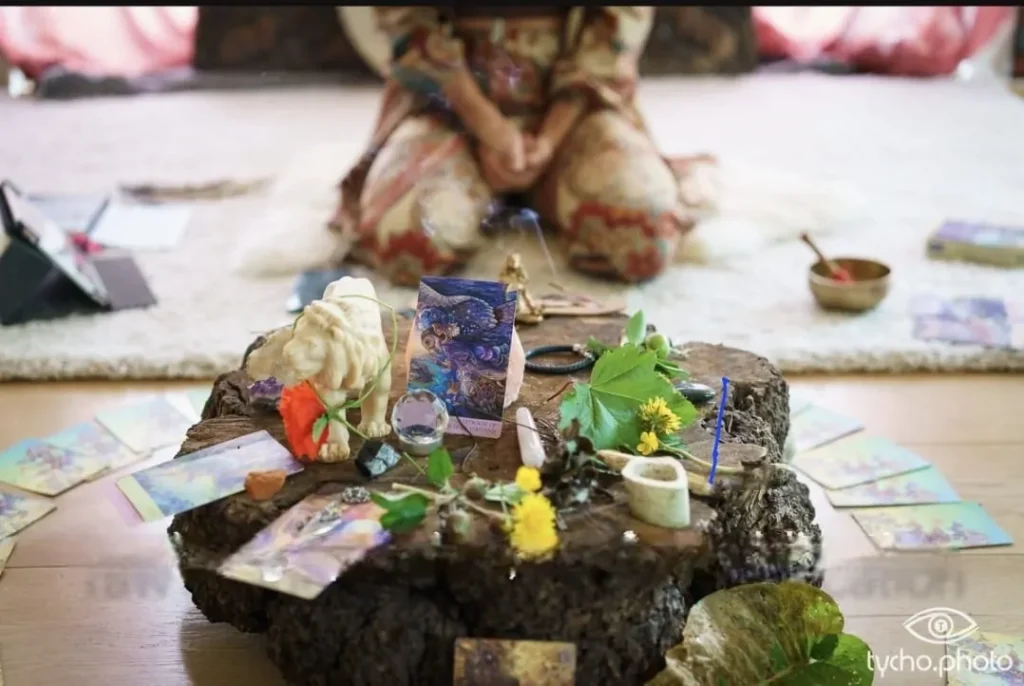
An Unexpected Call My mobile buzzes in my pocket. It’s my mum. “Hello,” I say, barely paying attention as I clumsily turn over pieces of tofu frying in the pan. “I’m in the hospital,” she says. “They’ve found something that may or may not be cancer.” A contraction forms in my chest, my breath tightens, and I feel a rigid sense of calmness. We speak; I say all the right things. But after I end the call and sit on the edge of my bed, a powerful emotion tightens like a physical pain in my chest: fear. The Issue with Emotions as “Owned” or “Separate” In the Global North, we’re often taught to see emotions as either separate from us or as something we “own.” These beliefs can shape how we relate to our emotions in unhelpful and unhealthy ways: If emotions are “mine,” I may feel responsible or at fault for them. If emotions are not “mine,” someone else is responsible for my feeling them, so I blame them. If emotions are separate from me, then I may believe I must get rid of them. If emotions define me, I may see them as part of my personality, like being “an angry person.” These views make emotional regulation challenging and can lead us to suppress, reject, or feel overwhelmed by emotions. Over time, these emotions may become “stuck,” leading to numbness, anxiety, or depression. These views – underpinned by our belief in separation and ownership – make emotional regulation challenging and can lead us to suppress, reject, become numb to or feel overwhelmed by emotions. They can lead to emotions becoming permanent rather than fluctuating, as we can see in anxiety disorders and depression. A Tantric Approach to Emotions Tantra is a non-dualistic tradition that understands everything is interconnected—simultaneously part of and separate from everything else. It also teaches that all forms, including non-material forms such as emotions, are sentient, self-aware beings. What if we approached emotions from this tantric perspective? Let’s revisit the fear I felt from my mother’s news. From the tantric worldview: The source of fear: I would understand that this fear arises not only from news of her ill health but also from all my past experiences with her that have led me to love her—for without that love, I would not feel this fear. Expanding perspective: I would understand that this fear is shaped not only by all the people and circumstances that enabled my experiences with my mother but also by those that led my mother to be the person that she is. To have become pregnant with me and to live her life with me. That this emotion of fear is interconnected even to the experiences her parents had, which led to her to be born and to be the person she is. I would see this emotion as both part of and separate from everything else. Sentience: As I would understand all forms to be sentient, I would believe that this emotion—fear—to be its is its own being, a Spirit that has come to visit me. Attitude: I may understand that a visit from a great Spirit is a rare gift, that it has come to me for a reason and is an opportunity to learn a valuable lesson. I may think it wise to make an offering of gratitude, to listen to what it has come to teach me. Seeing Emotions as Visiting Spirits By viewing emotions as interconnected and conscious, we can relate to them differently. Instead of suppressing or rejecting emotions, we can welcome them and listen to their messages. Taking a tantric approach to your emotions can support us towards: A healthier relationship with our emotions. This allows emotions to move naturally and avoids the physical and psychological challenges which occur when our emotions become  ‘stuck’ in our bodies. Why not see if I am right? Next time you experience a strong emotion, use the following tantric technique? Try This Tantric Practice for Emotional Regulation Choose an Object Select an object that represents the emotion you’re experiencing. Create a Quiet Space Sit as if to meditate in a quiet place, away from the noise of daily life. Place this object before you. Begin the Ritual by Bowing to the Object Say the following out loud or in your mind: Your name That you are calling in this emotion That you’re grateful it has chosen to visit you That you are open to the message it has for you Entering an Expanded State Stretch your arms horizontally to the sides, thumbs pointing up, fingers curled into fists. Inhale deeply through your mouth, filling your belly, chest, and shoulders. Hold your breath while tightening your pelvic floor (the muscles you use to stop the flow of urine). Draw your stomach in and up toward your solar plexus, keeping your arms extended, thumbs up, and muscles tense. Hold this as long as you can. When you need to exhale, Exhale fully, relax your muscles, lower your arms and release your breath fully through your mouth. With your lungs empty, hold your breath for as long as you can while focusing on the object. When you need to breathe, let yourself breathe naturally and keep a gentle focus on the object. Feel Fully Have the intention to listen to the Spirit of the Emotions message. Allow yourself to feel the emotion entirely, embracing any discomfort. Memories may surface, sensations may arise, and your body may shake or make sounds. Allow this. Let go of any need to analyse or understand— messages from the Spirit of the Emotion are seldom literal. Understandings will arrive as felt-senses, images and knowings. If your mind wanders, gently bring your focus back to the object. Listen with your body. Allow whatever needs to move or to be felt or understood to emerge in your body.

Uncategorized

Can Tantra offer a path to meaningful rebirth?

I am a survivor of extreme abuse. My life today should be impossible. Tantra helped me to be reborn into meaning, purpose, deeply loving committed relationships and pleasure. It’s been a journey, but extraordinary, supernatural experiences of profound rebirth have been a vital part of my healing journey. Hi  I hope you’re having a beautiful festive season. These modern European expressions of the winter solstice – Christmas and New Year – are metaphors for rebirth, of beginning again. Before I was a tantra teacher, I was a storyteller. Winter is a wonderful time for stories – so here is a short SUPERNATURAL BUT TRUE tantric tale. Later in this newsletter, I’ll offer you a free gift that will excite anyone who has attended one of my events: an extraordinary, powerful, guided energy orgasm practice!   But for now, gather around the storytelling fire  A Tantric Rebirth The woman is old, and I don’t find her attractive. Why, I think, do I have to do this ritual with her? I glance across the room at the popular guy who has the three hottest women of the retreat serving him. I turn my attention to the older, bald guy, who will also be serving me and who I will inevitably have to serve when it’s his turn and sigh. I do not look at the third person of the ‘pod’ I’ve been assigned to – I can’t; if I do, I’ll turn bright beetroot red. She is beautiful, and I simply cannot do this ritual with her. I know in my bones she finds me ugly, intense and repelling, and she does not want to do it with me. The moment the ritual starts, she will, I am sure of it, refuse to touch me, and the pain of this will be unbearable. I am about to put my hand up and tell the tantra teacher I cannot do this, I just can’t. But as I look over, thinking about how to get the teacher’s attention, how to tell him I can’t do this, the tantra teacher swivels his head towards me. His glass-blue eyes are angry. His wrinkled face is heartless. Fear feels like it’s tearing my rib bones apart. I lie down. I squeeze my eyes shut. Please, please, please, I repeat over and over in the red glare of my closed eyes. The ritual consists of being intuitively touched by three people for three hours. We have been training all week on how to be guided by ’spirit’, so we are neither taking nor giving with our touch but allowing spirit to be channelled through us as we hold the intention of serving. As six hands begin to explore my body, my breath tightens to a knot inside my chest. I can’t bear it. A hand rests gently on my heart. Another caresses my hair and face. Hands sweep across my stomach, thighs, arms, my hands, my feet. My body softens, my eyes open for a moment and bent over me is my archetypal mother, my universal father, my timeless lover. Their faces are indistinct, a luminosity beneath their skin. Warm and held, I am. And in that moment, I scream, my lungs fill with air as if for the first time. The gentle eyes of the mother, her arms holding me tight, delight. The firm touch of the father. I am a young child playing around the fire. And as the candyfloss-soft hair of the lover tickles my belly, a yearning so strong for my sex to be accepted, welcomed and loved as part of who I am. Suddenly, the tantra teacher comes over. His hard, angry eyes. My abusers have come. The memory is sharp, a PTSD flashback. I recoil, twisting away. Fear breaking my rib bones into sharp shards of glass puncturing my lungs. Again, I can’t breathe. But now the mother wraps me in her arms, stroking my hair. ‘It’s alright, it’s alright.’ The strong presence of the father holding me tight. The kind eyes of the lover telling me she is there, she is not going anywhere. My heartbeat slows with the gentle rhythm of their touch. The abuser is gone and this time I was not left alone. This time, my parents stayed. This time, I was protected. The wise touch of six hands soothe my body. My mind disappears. There is only light expanding across the sky of my awareness. Pleasure like none I’ve ever known, vibrating deep within the marrow of my bones. And when the lover’s hand caresses my yearning sex and the mother holds my beating heart, I explode. A full-body energetic orgasm, the first I have ever had, shatters my consciousness. A tunnel of light. And I have an extraordinary experience for which I simply don’t have the words: my soul, that had left my body for so long, I saw it, felt it, knew it, chose to return to my body. An understanding that, finally, it was safe to come home. My life was never the same after this rebirth. Whereas before, I could remember little, riddled with trauma as I was, after this ritual, I could remember and experience and despite many challenges, begin to enjoy my life. I was able to feel my energy body and to move energy up the channel of kundalini and begin in earnest the path I have followed ever since. A path of healing my trauma and training so I can give the loving wisdom of my vibration as a gift into the world. My gratitude for the healing power of my own rebirth experiences fuels my heartfelt desire to offer the gift of rebirth rituals to others who seek healing. I would be honoured if you would attend my upcoming Love, Death, and Rebirth ritual, February 6th to 9th. For my mailing list subscribers, I am delighted to offer a 10% discount using this code: NEWSLETTER10  Imagine This…  What if you could truly start over—not in a cliché “fresh

Blog_Pictogram-light.png-1.webp
Uncategorized

Tantra, mental illness and the Far Right

This month I am excited to share with you another winter story – an extraordinary experience that happened over the new year and set me thinking about something – I think you will agree – is both important and fascinating! So it’s cold outside, let us once again, gather around the storytelling fire  Picture this… A train. A plane. Another train. A 5-kilometer trek in the freezing dark, through a forest in the north of Denmark.  The smell of ancient gnarled trees. The darkness is complete, sweet, velvet. My hands, stiff without gloves, my nose stinging in the cold. At last, a house looms.  Its lighted windows, ghostly bright in the dark. I have arrived at the Ting Gathering—a conscious event, no drugs or alcohol allowed, anarchist in spirit, no official leadership and all decisions are made in a circle, passing a ‘speaking stick’ from hand to hand. Think workshops, kundalini yoga, and songs of oneness around a fire. And as I stumble out of the night and into the warmth, I find that the group is midway way through the evening circle. The atmosphere in the room is sour with tension. Why? A Palestinian flag is hanging on the wall and a man, holding the stick is demanding its removal:  that flag, he says, should be burned. My rib bones feel as if they are being crushed. Before I know it, despite the fact that I’ve just arrived, I’m standing up, words pouring from me unbidden. “My father is Palestinian. He could be shot by a settler or soldier at any moment. How can you say that?” Silence, thick and suffocating fills the room. “It was a joke,” the man mutters. The stick is passed. Another man stands up and says: This flag should be up as a protest against the Rothschilds who are behind these atrocities. Again, I’m on my feet: “My mother is an Israeli Jew who like countless Jews opposes this genocide. How dare you defend Palestinians by spreading antisemitic conspiracy theories?” The next days are a knot of frustration. I am utterly bewildered by the opposition to showing solidarity for the two million Palestinians in Gaza who are being systematically exterminated in the most horrific ways with the support of our governments. I am shocked at the levels of explicit antisemitism tolerated at the gathering. Some spend hours and hours in circle debating the issue. Men and women in their 50s’ and 60s’, acting like three-year-olds, rave on and on while the room slowly empties and people shout for them to pass on the stick. I don’t seem to be able to walk from my dormitory to the bathroom without being harassed about the issue. A man, full of aggression, shouts at me for wanting the flag on the wall. When others intervene to protect me, he starts sticking his tongue out and making farting sounds whenever anyone speaks to him. Another man follows me around, wanting to find out if I am an Ashkenazi jew, trying to convince me that they rule the world. Yet another harasses me telling me to build a “watermelon shrine” for my father. Poor mental health seemed to abound at the gathering: an ambulance is called for a woman who is suffering from acute psychosis. Finally, the conflict over the flag reaches a climax when someone steals the flag. It’s never seen again. Disillusioned and concerned by what I had witnessed and experienced, I chose not to spend New Year’s Eve there.. Why does the conscious community attract people with Far-Right views and mental health issues? Spiritual modalities such as tantra and shamanic plant medicine are powerful tools for healing. They can address PTSD, depression, anxiety, and more. It is no surprise, that those grappling with mental health issues are drawn to such spaces. I was one of those people and I am deeply grateful for the benefit I received from such practices. However, there is a more sinister reason for the prevalence of far-right views within conscious communities. Spiritual experiences often open us up to the possibility that the world is not as it seems. For example: I remember the first time I felt my aura with my hand or when, in a trance, I spoke a language that I did not know. These moments shook me to my core. I’d been told such things were impossible, and yet there they were. I felt I had been lied to. This made me open to the idea that there is more going on than I have been told. Social media companies know that individuals who have had mystical experiences tend to be more receptive to questioning conventional narratives and established explanations of reality. It’s for this reason there algorithms define those who are  ‘spiritual’ as ‘persuadable’. We are then targeted with Far-Right propaganda which reinforces the idea that “we are being lied to”. Sophisticated campaigns frame democratic systems that limit corporate profit, as threats to individual freedom and portray women, immigrants, trans people, Muslims and black communities as threats. This propaganda directs anger at scapegoats and diverts attention from the real cause of the crisis: the largest transfer of wealth to the richest 1% in human history. Today, inequality has reached unprecedented levels. Why does this matter? In Europe, nearly all indigenous wisdom was eradicated during the brutal slaughter of Pagans. In the Americas, over 95% of indigenous peoples were wiped out. The origins of the spiritual practices that you may have used will have l roots in indigenous and non-western communities and cultures. These practices survived because of the bravery of those who fought and refused to let their cultures and traditions die. If you’ve benefited from spiritual practices, I urge you to honour their origins and to recognize the courage of the Indigenous and non-white peoples who, despite colonization, genocide, and violence, kept these powerful worldviews alive. If for no other reason than gratitude for the bravery and sacrifice that enables you to now benefit from such powerful healing modalities, let’s confront

Scroll to Top